


Last Updated:
January 30th, 2026
Gaming addiction: Signs, symptoms and side-effects
The World Health Organisation officially recognised gaming disorder as a medical condition in 2018, finally acknowledging that excessive gaming can become a serious addiction. Around 12% of boys and 7% of girls in the UK show signs of gaming addiction, with some even playing for 12 to 20 hours every single day. Gaming addiction can harm your education, mental health, family life, and future prospects, but treatment is available for anyone looking to get help.
What is gaming addiction?
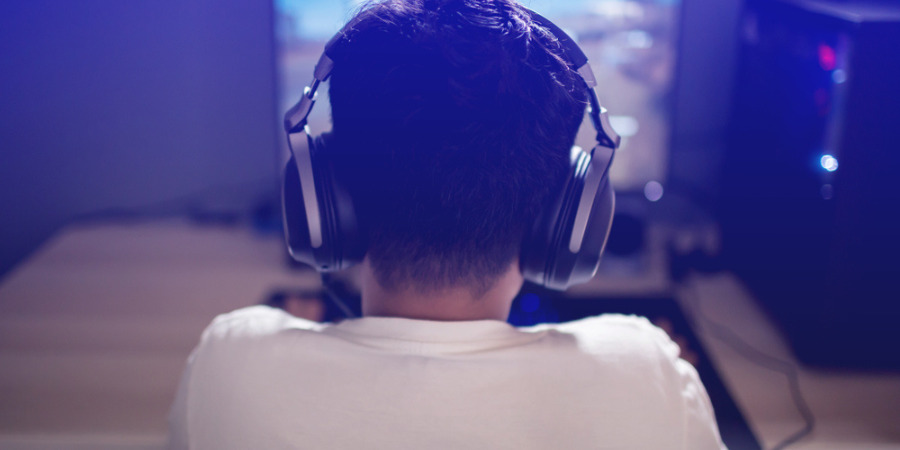
Gaming addiction means you have lost control over how much you game, and keep playing despite knowing it is harming your life. It is a widely recognised medical condition, including by the WHO, which defines “gaming disorder” as a pattern where you cannot control your gaming, prioritise it above everything, and keep going even when serious problems pile up.
How does gaming addiction develop?
Computer games provide small, incremental rewards, such as completing missions, unlocking achievements, and levelling up characters. You start playing for fun, but each reward triggers dopamine in your brain, the chemical that makes you feel good. Our brains love dopamine, so they want another hit, and that gets you playing more often.
Alongside the dopamine effects, computer games are also designed to be inherently addictive. There is always another challenge or level, and so one hour can become three, five, and then all night. As this pattern escalates, you start thinking about the game when you’re not playing, planning your day around when you can get back to your computer, and pushing everything else aside for more gaming time.
Gaming addiction takes hold when you realise you can’t stop, even though you want to, and when professional help is needed to avoid serious problems.
How to spot gaming addiction signs?
Gaming addiction can be hard to spot because playing computer games is a really common pastime. You may argue that all your friends play games as much as you do, and this can put you in addiction denial. If you’re really not sure whether there is a problem, here are some telltale gaming addiction signs:
No faq found!
- Playing for extremely long sessions
- Gaming through the night and sleeping through the day
- Becoming very angry, upset, or aggressive when you can’t play
- Lying to family about how much time you spend gaming
- Skipping school, college, or work to keep playing
- Stopping seeing friends or doing hobbies that you enjoyed before
- Ignoring personal hygiene or not eating properly
- Playing instead of eating proper meals, or eating only while gaming
- Experiencing physical problems from gaming all the time
- Feeling you cannot cope with life without gaming
- Trying to quit or play less but failing
Why is gaming addictive?
What many people don’t understand is that computer games are deliberately built to keep you hooked. Understanding how this works helps you see that you’re not weak in some way, but are the victim of expert design meant to maximise playing time:
What does gaming addiction recovery involve?
Residential behavioural rehab offers the most comprehensive and effective treatment for severe gaming addiction. It provides an inpatient environment completely free from gaming triggers, which is crucial because, while there is no substance detox, the first few days of digital detox can still come as a shock.
Rehab programmes then offer a range of evidence-based and holistic therapies. This will help you explore why gaming became so important to you and, in particular, the underlying personal problems it has been hiding. You can then learn other ways to face or manage these situations or feelings without disappearing into the gaming world.
After residential treatment, structured aftercare, relapse prevention planning and ongoing help are very important. This will usually include a mixture of services provided by your rehab centre and local support in your area. There are also various apps and software which can be used to restrict gaming at certain times or even prevent it altogether.
We understand gaming addiction is a serious medical condition, and we specialise in connecting families with the highest-rated treatment centres. Contact us today for confidential advice about the best recovery options for you or your loved one.
Frequently Asked Questions
(Click here to see works cited)
- NHS England. “Children treated for computer gaming addiction under NHS Long Term Plan.” NHS England, October 2019, https://www.england.nhs.uk/2019/10/children-treated-for-computer-gaming-addiction-under-nhs-long-term-plan/.
- NHS England. “NHS treats hundreds with gaming disorders.” NHS England, March 2023, https://www.england.nhs.uk/2023/03/nhs-treats-hundreds-with-gaming-disorders/.
- Sharman, Steve, et al. “The National Centre for Gaming Disorders (UK) – Who is accessing this service?” Journal of Behavioral Addictions, vol. 11, no. 2, April 2022, pp. 147-149, https://pmc.ncbi.nlm.nih.gov/articles/PMC9295212/.
- Cybercrew. “Video Gaming Addiction Statistics UK [2024].” Cybercrew, February 2024, https://cybercrew.uk/blog/video-gaming-addiction-statistics-uk/.
- World Health Organization. “Gaming disorder.” WHO, https://www.who.int/standards/classifications/frequently-asked-questions/gaming-disorder.
- Mullen, Jethro. “Baby Dies after Parents’ Online Gaming Binge.” ABC News, 8 Mar. 2010, https://abcnews.go.com/International/TheLaw/baby-death-alleged-result-parents-online-games-addiction/story?id=10007040.